
Here are the 10 most recent posts, listed with an image, publication date, headline, text excerpt, and hashtags. Older posts can be accessed via the search function, the archive links, and the tags on the right-hand side.

Who doesn’t have a piece of hardware or two at home that hasn’t received updates in years but continues to do its job quietly in the background?! Aside from devices that appear in the news because they’ve been misused in bot armies, their usefulness is also hampered by the advancing technology they’re supposed to support. I’d like to share one such example today: A Western Digital MyBook Live NAS,...
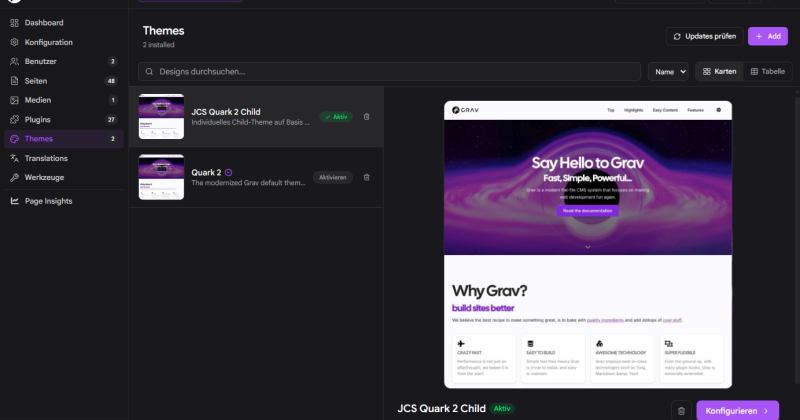
For me, it started with minor formatting tweaks—little things that bothered me, like how something looked or how much space it took up or wasted—and I soon came across an empty custom.css file in the Grav Quark theme that was intended for such customizations. Don’t do that—plugins and themes aren’t updated during so-called “updates”; they’re deleted and the new version is installed. Your changes...

I developed the new Grav plugin Social Linking because I felt the CMS used here was missing a certain feature. At the end of my posts, I like to link to a corresponding post in the Fediverse (I use Mastodon) to share it on the blog and discuss comments there. Until now, however, there was no way to include posts from the Fediverse in my blog articles beyond simply linking to them (or using scree...

Feed Teasers Vorschau

I developed the new "Feed Teasers" plugin for Grav because the CMS I am currently using lacked a feature I had previously employed on my WordPress blog to highlight or link to news from other websites. Back then, security alerts from Heise Security and the Tagesschau news feed were prominently displayed on the blog's homepage. Here, I also use this option to link to the latest posts from this...

I cope with my depression by finding distractions, and what better way to do that in the long run than by learning something new or rediscovering something I thought I’d forgotten? These are often small projects that can be completed in a few days or even a few hours. Sometimes I can’t sustain my interest, or unexpected costs come up that I hadn’t planned for, and then it’s over before it’s real...

There is no such thing as artificial intelligence! What is marketed as AI today is little more than pattern recognition—a process that, in its generalized form, is already hitting the limits of feasibility. The correct term would be "Large Language Model" (LLM), though this actually has more to do with vectors than with language. Current large-scale models are reaching a point where adding more pa...

How Politicians Distort Statistics to Push a Political Agenda

Chancellor Merz, Vice Chancellor Klingbeil, and Minister President Kretschmann all claim in unison: People in Germany don’t work hard enough. The figures they cite, however, tell a different story—or rather, they are presented in such a way as to tell a specific story.


The Narrative and Its Goal

“Overall...

Bulletin Board Systems (BBSes) were something of a precursor to the Internet. Back then, you would dial into such a system over a telephone line using a modem and terminal emulator to—for example—download files, exchange messages, or play simple arcade games. If you find this history interesting, I recommend the FidoPedia page as a starting point for further research; going into detail here wou...

Anyone who regularly administers Linux servers will find themselves repeatedly performing the same tasks to ensure the system is running as intended. When dealing with only a few systems, this is usually done directly via SSH, as the effort of maintaining dedicated remote management tools is rarely worthwhile. So why not simply create a script that executes quick commands and filters the output to...

Debian maintainers have long worked on Year 2038 compatibility and announced its completion with the release of Debian 13 (Trixie). This is based on the fact that Linux stores system time—and all date fields derived from it—as a signed 32-bit integer representing the number of seconds elapsed since January 1, 1970, at 00:00: 231 - 1 = 2.147.483.647


This works until January 19, 2038, at 03:14:0...